Early Warning Signals of a Social Media Crisis
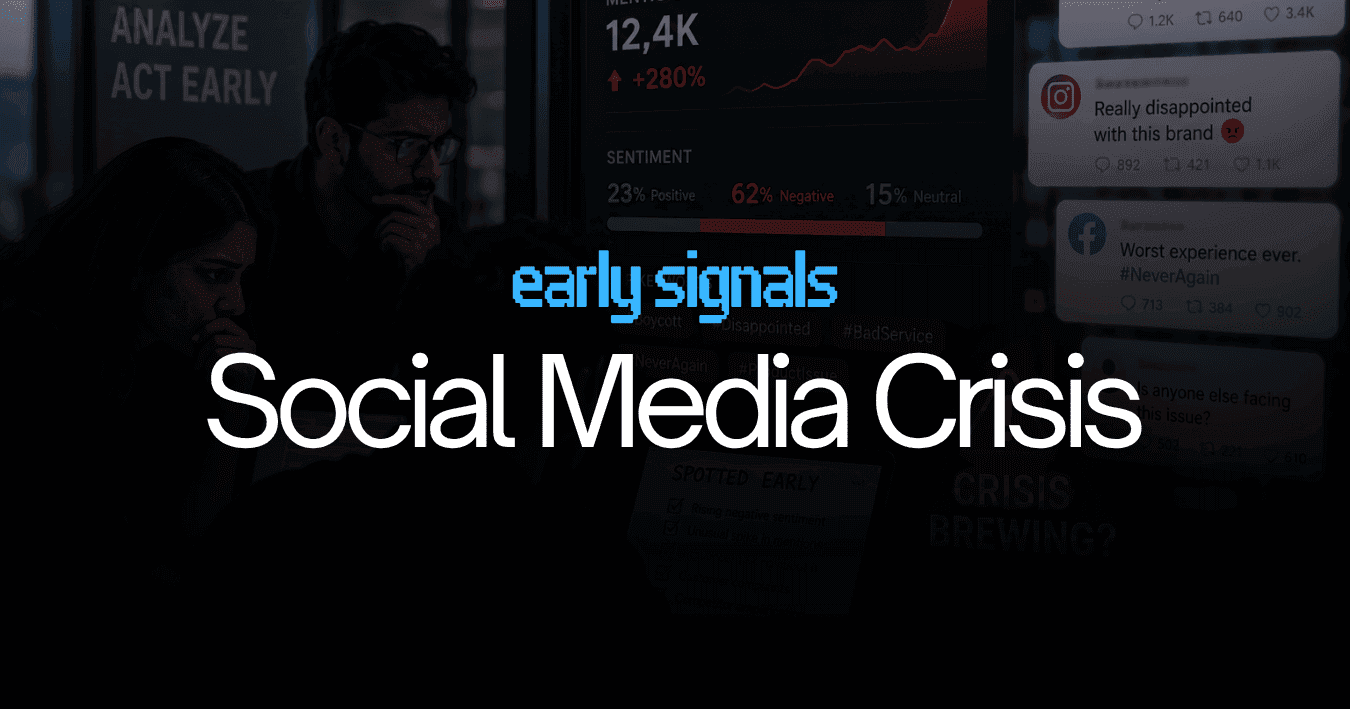
By the time a social media crisis is trending, it's already too late to prevent it, you're managing it now, not preventing it. The brands that come out of a crisis looking competent aren't the ones with the fastest apology template. They're the ones who noticed something was wrong three days before anyone else did.
Every major social media crisis has a "we should have seen this coming" moment buried in its timeline. Usually, someone did see it, a spike in a niche forum, a cluster of near-identical complaints, a comment thread that got a little too quiet. It just didn't get flagged until the story had already left the brand's control.
Here's what those early signals actually look like, and why most monitoring setups miss them.
Why Crises Feel Sudden But Rarely Are
A crisis "breaking" is really just the moment a slow-building problem crosses a visibility threshold, an influencer picks it up, a journalist notices it, or enough people pile on that the platform's algorithm starts pushing it wider. The underlying issue was usually there for hours or days before that moment.
This matters because it means crises are, in principle, catchable earlier, but only if you're watching for the right signals, not just waiting for volume to spike. Volume is a lagging indicator. By the time mention count jumps, the moment for quiet, controlled intervention has usually passed.
The Early Warning Signals That Actually Matter
1. Sentiment Drops Before Volume Rises
This is the single most reliable early signal, and the one most basic tracking tools completely miss because they're built to alert on volume, not tone. A cluster of sharply negative comments on a small number of posts, even if total mentions look flat; is often the first real signature of a brewing issue. Sentiment dips first; volume follows once the story finds an audience.
2. The Same Complaint Starts Repeating, Word-for-Word-Similar
One frustrated customer is an anecdote. Five people describing the identical problem in similar language, across different platforms, within a short window, is a pattern and patterns are what tip a single bad experience into a systemic one worth acting on. Watch for repeated phrases, not just repeated topics.
3. A Shift From Public Complaints to DMs and Screenshots
Ironically, a drop in public complaint volume can be a warning sign, not a relief. When frustrated customers start screenshotting a bad interaction and sharing it privately, or moving the conversation into closed groups and community forums, it often means the story is being built quietly before it goes public and it tends to arrive with more force when it does.
4. A Micro-Influencer or Niche Community Starts Talking
Most crisis-monitoring instinctively watches for big accounts. But the earliest signal is frequently a smaller, highly-trusted voice in a specific community a regional creator, a niche subreddit-equivalent, a WhatsApp group with genuine local trust, picking up on the issue well before it reaches anyone with a large national following. By the time a big account notices, the story has already been vetted and amplified by smaller, trusted nodes first.
5. Tone Shifts on Unrelated Posts
If negative sentiment starts leaking into comments on posts that have nothing to do with the actual issue, a festive campaign post suddenly getting complaint comments about a delivery problem, that's a sign the underlying frustration has become bigger than the original incident. People are using any available platform space to vent, which usually means the issue has crossed from "specific complaint" to "brand-wide grievance" in the audience's mind.
6. Competitor or Comparison Mentions Spike
A rise in posts comparing your brand unfavorably to a competitor, even without an explicit incident being cited, often means something has shifted in perception before anyone has articulated exactly why. This is a subtler signal, but a real one, sentiment erosion frequently shows up as comparison before it shows up as complaint.
7. Regional-Language Chatter Precedes the English Conversation
In a market like India, this is one of the most consistently missed signals. A complaint or controversy often surfaces first in Hindi, Tamil, Bengali, or another regional languages, in a local Facebook group or regional YouTube comment section, well before it appears in English on X or Instagram. Brands and tools that monitor primarily in English are, in effect, waiting for the second wave to notice the first one.
Why Standard Monitoring Tools Miss These Signals
Most monitoring setups are built around volume thresholds: alert me when mentions cross X in Y hours. That catches a crisis after it's already visible, which is useful for triage, but useless for prevention.
Catching the signals above requires:
- Sentiment tracking sensitive enough to flag tone shifts on low mention-volume, not just spikes
- Semantic clustering that recognises similar complaints even when the wording isn't identical
- Coverage across regional languages and smaller platforms, not just English-language, high-reach accounts
- The ability to separate "noise" from a genuinely repeating pattern, without waiting for a human to manually notice five separate posts
This is precisely where a lot of "monitoring" tools stop and real social listening infrastructure begins, the difference between a tool that tells you a story is trending and one that tells you a story is forming. It's also why treating regional and code-mixed language as core input, not an edge case, matters so much for early detection in a market like India, a design principle platforms like Awshar AI have leaned into specifically because so much early crisis signal in India starts outside English-language, metro conversation.
What to Do When You Catch an Early Signal
Spotting the signal early only helps if the response matches the scale of what you've actually found:
- Verify before escalating. A cluster of similar complaints deserves a quick internal check, is this a real, spreading issue or a coincidence?
- Respond at the scale of the signal, not the scale of the fear. An early, quiet issue usually needs a direct, low-drama fix, not a public statement that draws more attention to something that hadn't gone wide yet.
- Fix the root cause, not just the loudest comment. If it's a genuine pattern, the visible complaints are a symptom; the underlying issue needs addressing before the next wave of mentions arrives.
- Keep watching after the dip. Sentiment can look like it's recovered while the underlying frustration is still building in smaller, less visible spaces.
Frequently Asked Questions
What's the earliest reliable sign of a brewing social media crisis? A sentiment drop concentrated on a small number of posts, before overall mention volume increases, sentiment tends to shift before volume does.
Do social media crises usually start in mainstream feeds or smaller communities? Most start in smaller, trusted spaces, niche communities, regional-language groups, or micro-influencer audiences, before reaching mainstream, high-visibility accounts.
Why does regional language matter in crisis detection for Indian brands? Because a significant share of early complaint and controversy activity in India surfaces first in Hindi or regional languages, often on platforms that English-only monitoring tools don't cover well.
Can volume-based alerts alone prevent a social media crisis? No, volume-based alerts are a lagging indicator. By the time mention volume spikes, the story is usually already public and spreading, which limits the response to damage control rather than prevention.
The Bottom Line
A social media crisis rarely arrives without warning, it arrives without anyone watching the right signals. Volume spikes tell you a story is already out. Sentiment shifts, repeating complaints, regional-language chatter, and quiet community conversations tell you a story is forming. The difference between a brand that manages a crisis well and one that prevents it almost always comes down to which one it was actually listening for.
Read Next
Social Listening for Tier 2 & Tier 3 Cities in India
India's next wave of digital growth is coming from Tier 2 and Tier 3 cities. Learn why social listening built for these markets, not just metros is now essential for brands.
social listening vs social media monitoringSocial Listening vs Social Media Monitoring: What's the Difference?
Social listening and social media monitoring sound similar but solve different problems. Learn the real difference, when to use each, and how brands in India's multilingual digital space are combining both.