When the Content Is Real but the Claim Is False: The Blind Spot in Misinformation Detection
Ask most teams what misinformation looks like and they will describe something fabricated: a doctored image, an invented quote, a made-up news site. Most detection tooling is built around exactly that picture.
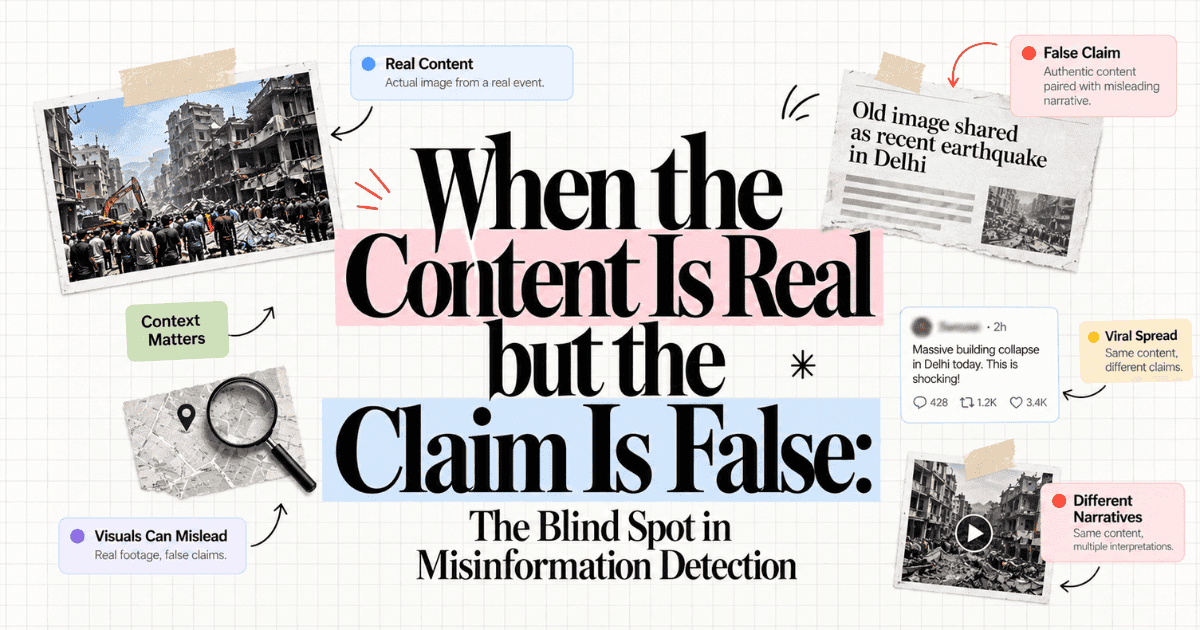
But some of the most damaging false narratives in India involve nothing fabricated at all. The video is real. The photograph is real. The screenshot is real. What is false is the sentence attached to it: this happened today, this happened here, this was done by this company.
This is out-of-context misinformation, and it is the blind spot in how many brands, newsrooms and institutions think about detection.
What “real content, wrong context” actually looks like
The media is authentic. The claim around it is not. In practice, the false claim usually gets one of five things wrong:
- Time: an old clip is shared as breaking news, often years after the original event.
- Place: footage from one city, state or country is captioned as if it happened somewhere else.
- Entity: a genuine customer complaint about one company is attributed to another with a similar name or logo.
- Frame: a long statement or video is trimmed so that its meaning flips.
- Scale: one isolated incident is presented as a pattern, or a pattern as an isolated incident.
Consider an illustrative scenario. A genuine video of a packaging defect from a small regional distributor starts circulating with a caption claiming it is from a national brand’s latest batch. Nothing in the video is edited. A manipulation classifier returns a clean result. A reverse image search confirms the footage is authentic. And yet the brand is now dealing with a product-safety rumour.
Why it spreads so well in India’s information environment
The World Economic Forum’s Global Risks Report 2024 ranked India highest among surveyed countries for the risk of misinformation and disinformation, and the 2025 edition again placed it among the top five risks for India. Several features of the Indian information landscape make the out-of-context variety especially hard to contain.
The lie lives in the caption, and the caption is multilingual. The same genuine clip can circulate with different false captions in Hindi, Tamil, Bengali, Marathi, Romanised Hindi and Hinglish, each one telling a slightly different story to a different audience. A monitoring setup that reads only English captions sees a fraction of the picture.
Media travels without its history. When a video is forwarded, downloaded and re-uploaded, or captured as a screenshot of a screenshot, the signals that could reveal its origin (the original upload date, the first poster, the surrounding conversation) are stripped away.
Familiarity lowers suspicion. Real footage feels credible precisely because it is real. People who would question an obviously edited image tend to trust a genuine one.
Why the usual detection stack misses it
Traditional approaches each have a specific gap when the media is genuine:
- Manipulation detection looks for edits, synthetic faces and tampered pixels. Genuine media has none.
- Claim matching against fact-check databases works only after someone has already checked that exact claim, and usually in a limited set of languages.
- Keyword monitoring catches mentions of a brand, but not a false story that never names it in text and exists only in a video or an image.
- Sentiment analysis can show that negativity is rising, but not whether it is rising because of something true.
The falsehood sits in the relationship between the media and the claim, and between the claim and the calendar. Detecting it means examining that relationship rather than the media itself.
A four-question framework for detecting misplaced truth
Teams that handle this well tend to ask four questions of any piece of viral content.
1. Provenance: when and where did this first appear? The earliest known appearance of a piece of media is the single most useful fact about it. If a video is being described as “yesterday” but first surfaced two years ago, the claim collapses. Establishing first-seen requires looking across platforms and over time, not just at the post in front of you.
2. Fit: does what is claimed match what is shown? Compare the assertion with the evidence inside the media: visible signage, number plates, currency, weather, language spoken in the audio, text on packaging. Much of this text appears in Indian scripts, so reading it reliably requires language-aware tooling rather than English-only OCR.
3. Carriers: who is spreading it, and how? A genuine rumour spreads through varied people at varied times. A manufactured push tends to show identical captions pasted across many accounts, tight timing clusters and newly created or low-history accounts. Carrier behaviour often separates organic confusion from deliberate amplification.
4. Recurrence: has this story come back before? Recycled media resurfaces around predictable triggers such as festivals, sale seasons, exam results, elections and fresh incidents. A narrative that has surfaced and faded several times will probably surface again, which is one reason historical conversation data is more valuable than it first appears.
What brand and communications teams can do
Monitor media, not just keywords. A false claim about your brand may appear only as a video or an image. Detection has to follow the content itself across platforms and languages.
Triage by harm, not by truth alone. Not every out-of-context post deserves a response. A useful split is harmless (confusion with no consequence), misleading (spreading and shaping perception) and harmful (affecting safety, health, finances or public order). Spend response effort on the last two.
Respond with context, not denial. This is where many teams go wrong. If the video is real, calling it “fake” destroys credibility the moment someone verifies it. A stronger correction concedes what is true and fixes what is not: this footage is genuine, but it is from a different year and a different company.
Keep a library of verified assets. Original release dates, official statements, product batch information and authentic imagery give your team something to compare against in minutes instead of hours.
Watch the early minutes. As with any early warning signal, the window before a rumour reaches mainstream pickup is when a correction costs least and works best.
Where technology fits in
None of this is feasible by hand at the scale of India’s digital conversation. It calls for systems that can trace how a claim propagates, identify where it first appeared and how fast it is moving, and do so across hundreds of sources and across languages. This is the kind of work platforms such as Awshar AI are built around: following claim propagation from origin to reach across 500+ sources in 20+ Indian languages, so that a team sees the story’s trajectory and not only its latest post.
The takeaway
The question “is this fake?” is the wrong first question. A better one is “is this true here, now, and about this brand?” Misinformation detection that can only recognise fabrication will keep missing the stories that spread fastest, because those stories are told with real footage and real screenshots.
Teams that learn to detect misplaced truth, not just manufactured falsehood, respond sooner, correct more credibly and lose less trust along the way.
Frequently asked questions
What is out-of-context misinformation? It is misinformation in which the underlying photo, video, document or quote is genuine, but it is presented with a false claim about when, where, by whom or why it happened.
Why can’t deepfake or image-manipulation detectors catch it? Those tools look for signs of editing or synthetic generation. Out-of-context content has not been edited, so there is nothing for them to find. The falsehood is in the caption and the claimed context.
How should a brand respond when the viral content is genuine? Acknowledge what is authentic, clearly correct the false context (date, place, company or scale), and share verifiable supporting information. Calling genuine content fake usually backfires.
Does language matter for detecting it? Yes. In India, the same genuine media often circulates with different false captions in different languages and scripts, including Romanised Hindi and Hinglish. Detection that works in only one language misses most variants.
How quickly should a team act? As early as possible. The period before a claim is picked up by large accounts or media outlets is when a correction is most effective.
Read Next
Why News & Research Platforms Need Social Intelligence
With a major incident breaking somewhere in India nearly every day, news and research platforms can't rely on traditional reporting cycles alone. Here's why they need social intelligence support.
Historical Data Social ListeningWhy Historical Data Matters in Social Listening
Real-time alerts get all the attention, but historical social data is what turns listening into strategy. Learn why past conversation is essential context, not old news.