Indian Local Body Elections and Social Listening
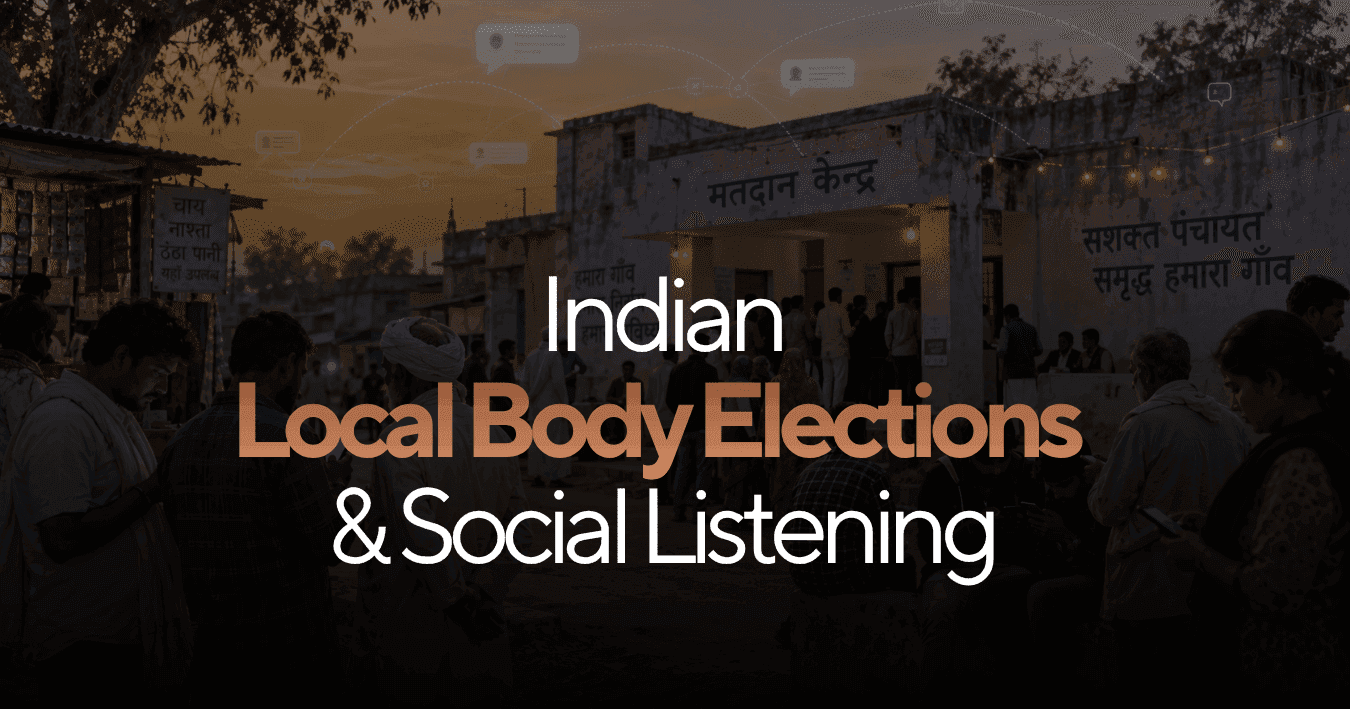
National elections get the war rooms, the primetime debates, and the nationwide sentiment trackers. Local body elections; panchayat, municipal corporation, zila parishad, ward-level contests, get almost none of that infrastructure, despite deciding who actually controls roads, water supply, garbage collection, and local law and order for millions of people.
That gap is starting to close, and social listening is a big part of why. Local elections generate an enormous amount of digital conversation, just not in the places or the languages that national-level tracking tools are built to catch.
This isn't about predicting winners or taking a political side. It's about understanding a genuinely different kind of election conversation, and why the tools built for tracking it need to look different too.
Why Local Body Elections Are a Different Animal
National elections are, in a sense, easier to track: a handful of major parties, national issues, English and Hindi-heavy coverage, and heavy traditional media presence. Local body elections flip almost every one of those assumptions.
- The issues are hyperlocal. A ward-level contest might turn entirely on a drainage problem, a disputed water connection, or a local land dispute, issues that never make it into national news but dominate the conversation in a specific neighbourhood's Facebook group or WhatsApp community.
- The candidates are often independents or local faces, not national party figures with existing social media infrastructure and dedicated digital teams.
- The language is almost entirely regional or code-mixed; a municipal election in Amalapuram is being discussed in Telugu and Tanglish, not English, and a panchayat election in Bihar is happening in Hindi, Maithili, Bhojpuri, and various local dialects, often in the same thread.
- The platforms skew toward closed and semi-closed spaces WhatsApp groups, local Facebook communities, regional YouTube channels, rather than the open, easily-tracked feeds of X or Instagram.
- Traditional media barely covers it, which means social conversation is often the primary public record of sentiment, not a supplement to news coverage.
Put together, this means a listening approach built for national-level, English-heavy, open-platform tracking will miss most of what's actually happening in a local body election, and what it does catch, it will often misread.
What Social Listening Can Actually Reveal in a Local Election
1. Which Local Issues Are Actually Driving Sentiment
National narratives rarely map cleanly onto local ones. Listening at the ward or panchayat level can surface the two or three issues genuinely dominating conversation in a specific area, a broken road, an unresolved property tax dispute, a local infrastructure delay, that wouldn't show up in any state or national-level report.
2. How Sentiment Varies Ward-to-Ward or Panchayat-to-Panchayat
A citywide or district-level sentiment number is close to meaningless for local body elections, because sentiment can flip completely between adjacent wards based on entirely local dynamics. Granular, geography-tagged listening is what makes local election tracking useful at all, the moment you blend it into a single regional average, you lose the thing that made it valuable.
3. The Real Reach of Independent and First-Time Candidates
National-party candidates usually come with pre-built digital reach. Independent and first-time local candidates often build their presence organically, through community WhatsApp groups and local creators rather than paid campaigns. Standard reach and follower-count metrics tend to badly undercount this kind of grassroots digital presence, because it isn't concentrated in the accounts those metrics are built to weigh most heavily.
4. Regional-Language Conversation That English-First Tracking Misses Entirely
This is arguably the single biggest gap in local election tracking today. A large share of the real conversation around a municipal or panchayat election happens in regional languages, in scripts and phrasing that generic sentiment tools weren't trained on. Missing that conversation doesn't just create a blind spot, it can produce a confidently wrong picture, built entirely from the smaller, English-language slice of what's actually being discussed.
5. Early Shifts in Local Sentiment Before They're Reported Anywhere
Because local body elections get so little traditional media coverage, social conversation is frequently the earliest available signal of a shift in ground sentiment, well before any local reporting or on-ground survey catches up to it.
Why This Requires a Different Kind of Listening Infrastructure
Tracking a national election reasonably well is largely a matter of scale, more mentions, more accounts, more compute. Tracking a local body election well is a matter of precision, correctly reading a small, dense, hyperlocal, regional-language conversation without drowning it in irrelevant noise from the rest of the country.
That requires:
- Genuine fluency in regional languages and code-mixed text, not translation-layer workarounds that lose nuance and local idiom
- Geography-level tagging precise enough to separate one ward or panchayat from its neighbor, not just state or district-level buckets
- Coverage of closed and semi-closed platforms like WhatsApp-linked content and local Facebook groups, where a large share of this conversation actually lives
- Sentiment models tuned to local dialect and phrasing, since tone and idiom can shift meaningfully within the same state, let alone across regions
This is exactly the kind of problem that pushed a lot of the thinking behind purpose-built regional listening infrastructure in India — the recognition that "hyperlocal" isn't a smaller version of national tracking, it's a fundamentally different data problem. It's part of why platforms working on India's multilingual digital landscape, Awshar AI among them, have treated granular, language-native, geography-tagged listening as core infrastructure rather than a add-on layered onto a national dashboard.
Who Actually Uses This
Local body election listening isn't only useful to candidates and parties. It's used by:
- Media and research organizations trying to understand ground sentiment in areas traditional coverage doesn't reach
- Civic and governance researchers studying how local issues actually surface and spread online
- Local businesses and institutions trying to understand which civic issues matter most to a community they operate in
- Political consultants and campaign teams, across the spectrum, trying to understand hyperlocal sentiment rather than relying on state-level assumptions
The underlying value is the same regardless of who's using it: an accurate, granular read of what a specific community is actually discussing, in the language they're actually discussing it in.
Frequently Asked Questions
Why is regional-language coverage so important for local body election tracking? Because most conversation around panchayat and municipal elections happens in regional languages and dialects, not English, tools without genuine regional-language fluency miss the majority of the real discussion.
Can national election sentiment tools be reused for local body elections? Not effectively, national tools are typically built for open platforms and broader geography, while local elections need ward or panchayat-level precision and coverage of closed platforms like WhatsApp-linked communities.
Do independent local candidates get accurately tracked by standard social media metrics? Often not, their digital presence tends to be grassroots and community-driven rather than concentrated in easily-measured, high-follower accounts, so standard reach metrics tend to undercount them.
Is social conversation a reliable early signal for local election sentiment? It's often the earliest available public signal, given how little traditional media coverage local body elections typically receive, though it should be read alongside on-ground context rather than in isolation.
The Bottom Line
Local body elections in India run on hyperlocal issues, regional language, and community platforms that most listening infrastructure was never built to see clearly. As that conversation keeps growing, the gap between generic national-level tracking and genuinely local, language-native listening is only going to matter more, for candidates, researchers, and anyone trying to understand what a specific community actually cares about.
Read Next
Early Warning Signals of a Social Media Crisis
Most social media crises don't start with a bang, they start quietly. Learn the early warning signals brands miss and how to catch a crisis before it spreads.
Social ListeningSocial Listening for Tier 2 & Tier 3 Cities in India
India's next wave of digital growth is coming from Tier 2 and Tier 3 cities. Learn why social listening built for these markets, not just metros is now essential for brands.