Real-Time Social Media Monitoring for Government & Enterprise | Awshar AI
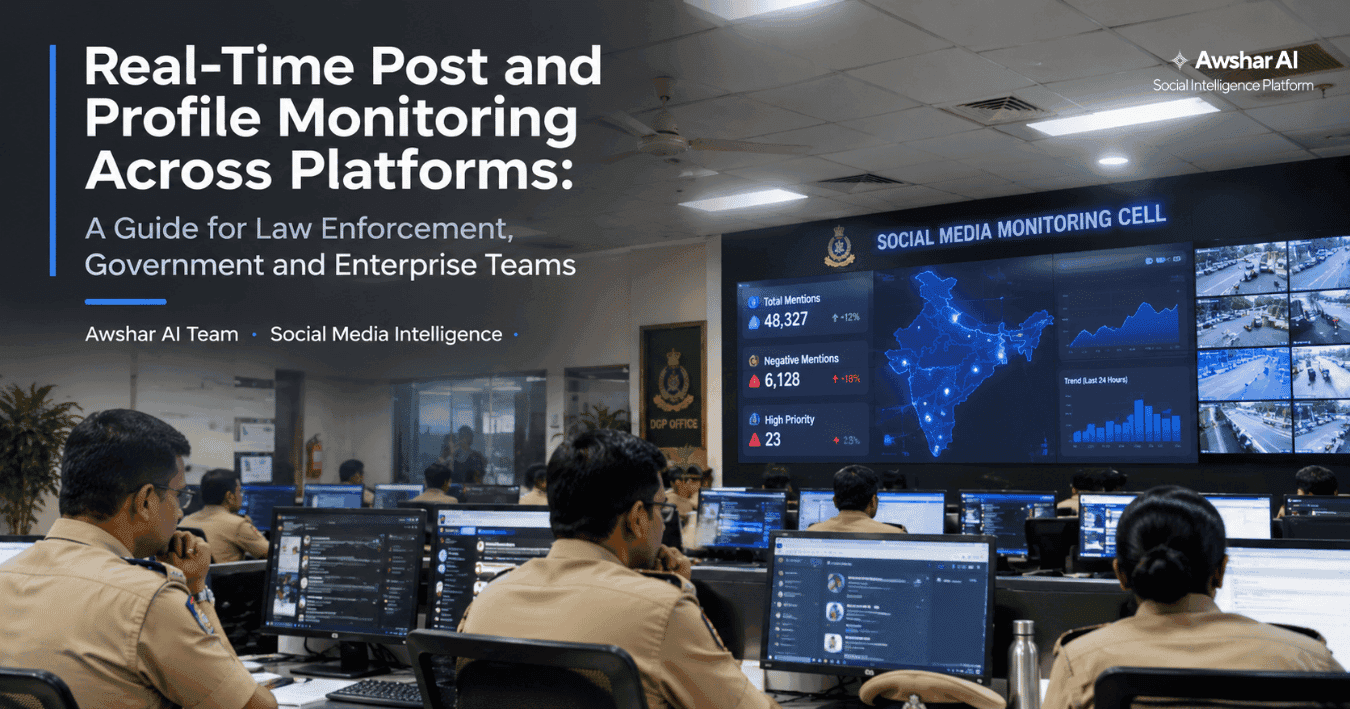
Most serious incidents now announce themselves online before they reach a control room. A rumour that could spark unrest, a fake customer-care handle collecting OTPs, a post from a flooded neighbourhood asking for rescue: each begins as a public post or profile, and each is most manageable in its first hour.
For law enforcement agencies, district and municipal administrations, government departments and large enterprises, the question is no longer whether to watch these signals. It is how to do so quickly, across platforms and languages, and in a way that can withstand legal and public scrutiny.
This guide explains what real-time post and profile monitoring involves, who uses it and for what, how it works, and the safeguards that separate a credible programme from a risky one.
What real-time post and profile monitoring actually means
The term covers four related ideas:
- Post monitoring tracks public content by keyword, topic, location, language, image or video. It answers: what is being said, where, and how fast is it growing?
- Profile monitoring tracks defined public accounts, such as official handles, impersonating accounts, high-reach amplifiers and accounts tied to a documented lawful purpose. It answers: what is this account publishing, and how is it connected to others?
- Cross-platform monitoring follows the same event or account across X, Facebook, Instagram, YouTube, public Telegram channels, news sites, blogs and forums, because stories rarely stay on the platform where they started.
- Real-time is a question of latency: the gap between a post going live and the right person being alerted. In fast-moving situations, minutes matter and hours rarely do.
This differs from classic social listening, which is designed to understand aggregate conversation and trends. Monitoring adds entity-level tracking, instant alerting and, where required, evidence capture.
Why speed matters: the first-hour problem
Four things tend to be true in the first hour of an incident, and they all favour the team that sees it early:
- Rumours harden. An early, accurate clarification is far cheaper than a late correction of a belief that has already spread.
- Harm scales with reach. A fraud campaign or impersonation account claims more victims for every hour it runs.
- Evidence disappears. Posts are deleted, edited or made private, sometimes within minutes.
- Response needs lead time. Verifying, deciding and mobilising all take time that only early warning can provide.
Who uses it, and for what
Law enforcement agencies
- Public-order early warning. Spotting rumours, calls for mobilisation or incitement in public posts before they translate into on-ground incidents.
- Cybercrime response. Detecting fake investment or loan pages, phishing campaigns and accounts impersonating officials or institutions.
- Public threats and emergencies. Identifying credible threats posted publicly, appeals about missing persons and first reports of incidents.
- Evidence preservation. Capturing public content with timestamps and integrity checks so it is available even if the original is deleted, in a form that can meet electronic-evidence requirements.
Administrative agencies
District administrations, municipal bodies, disaster management authorities and health and transport departments use monitoring for:
- Situational awareness during floods, fires, accidents and large public gatherings, where citizens often post first.
- Grievance detection, picking up citizens who tag officials or departments and routing those complaints to the right desk.
- Scheme and service rumours, such as false claims about benefits, eligibility or deadlines that can cause crowding and distress.
- Event management around festivals, examinations and election periods, when rumours spread quickly and carry high stakes.
Governments and public communication teams
- Understanding how policies and schemes are being discussed, in regional languages as well as English.
- Tracking narratives and misinformation about government programmes, and responding through official channels with accurate information.
- Spotting coordinated inauthentic activity that makes a fringe claim look like a groundswell. Our guide to detecting fake news using AI covers the underlying techniques.
Enterprises
- Impersonation and scam control. Fake brand pages, fake executive profiles and fraudulent customer-care handles that target your customers.
- Executive and event security. Publicly posted threats, doxxing and plans to disrupt events or facilities.
- Fraud and counterfeit detection, including leaked data, fake promotions and unauthorised sellers.
- Operational disruption. Early signs of protests, strikes, accidents or outages near plants, offices and supply routes.
- Crisis and reputation. Spotting a viral complaint or false claim early enough to respond, as discussed in our piece on early warning signals of a social media crisis.
How a real-time monitoring system works
Most capable systems follow the same sequence:
- Collect publicly available content continuously from social platforms, video, news and other open sources, using lawful and platform-compliant methods.
- Normalise and identify language, including mixed-language and Roman-script text that is common in India.
- Enrich each item by extracting entities, locations, claims, topics and media content.
- Connect posts, profiles and networks across platforms, using public signals and keeping a human in the loop for confirmation.
- Score and prioritise by combining spread velocity, source credibility, potential for harm and relevance to a defined watchlist.
- Alert with context, so the recipient sees what happened, where it started, how fast it is moving and who is amplifying it.
- Preserve and log, capturing evidence where required and recording who accessed what and why.
This is the architecture behind how we approach monitoring at Awshar AI: broad collection across 500+ sources, language-aware processing across 20+ Indian languages including Hinglish, and alerts that arrive with the context a team needs to act, within minutes rather than at the end of a daily report.
The hard problems
- Speed versus accuracy. Faster alerts mean less time to verify. Good systems alert quickly and show confidence levels clearly.
- Alert fatigue. If everything is urgent, nothing is. Precision and tunable thresholds are what keep a control room useful.
- Cross-platform identity. Linking accounts across platforms is error-prone. A false match can attach an innocent person to someone else’s conduct, so matches need confidence scores and human verification before anyone acts on them.
- Language. English-only tools miss a large part of India’s conversation. Detection has to work in regional languages, dialects and code-mixed text.
- Media. Much of what matters is video, images and text inside images, not plain text.
- Deletion and edits. Content can vanish, so capture and timestamping must happen close to the time of posting.
The part that cannot be skipped: governance and safeguards
Monitoring public platforms for public safety and organisational security is a legitimate activity. Monitoring without safeguards, however, erodes public trust and creates legal and reputational risk. Civil society groups in India and elsewhere have raised concerns about over-broad social media monitoring, and credible programmes address those concerns directly rather than avoiding them.
A responsible programme rests on a handful of principles:
- Public data only. No access to private accounts, no fake personas to enter closed groups and no circumvention of platform controls. Private, encrypted messaging falls outside the scope of social media monitoring.
- Defined purpose and legal basis. Every watchlist should be tied to a documented lawful purpose, such as a specific threat, investigation or operational need, and reviewed periodically.
- Proportionality. Scope should be no wider than the purpose requires. India’s Supreme Court, in its 2017 Puttaswamy judgment, recognised privacy as a fundamental right and established legality, legitimate aim and proportionality as the tests for restricting it.
- Humans decide. Scores prioritise; people make decisions. No adverse action should rest on an automated output alone.
- Audit trails and access control. Role-based access, with a record of who searched for what, when and why.
- Minimisation and retention limits. Keep what is needed for the stated purpose and delete the rest on a defined schedule.
- Protection of lawful expression. Criticism, satire and dissent are not threats. Systems and policies should distinguish unlawful content and genuine risk from the ordinary noise of public debate.
- Verification before attribution. Confirm identity and context before concluding anything about a person or an account.
- Independent oversight. Periodic review by someone outside the operating team strengthens both legitimacy and quality.
In our own approach, monitoring is built around publicly available data, and every alert is treated as a prompt for human review rather than a conclusion.
A brief note on the legal landscape
The rules are evolving, and this section is a general orientation rather than legal advice:
- The Digital Personal Data Protection Act, 2023 and its Rules, notified in November 2025, are being phased in, with most substantive obligations scheduled to commence in May 2027. Enterprises should plan now for their obligations as data fiduciaries.
- The Act provides exemptions for State instrumentalities notified on grounds such as security and public order. An exemption, however, is not a substitute for an internal policy on purpose, proportionality and oversight.
- Accessing private communications is a separate matter, governed by specific legal procedures and not by open-source monitoring.
- Evidence drawn from electronic sources should be captured and documented with the requirements of Indian evidence law in mind.
- Platform terms of service also apply to how data is collected.
Agencies and enterprises should have counsel review the specific design of their programme.
Questions to ask before choosing a platform
- Which platforms and sources are covered, and how is the data obtained?
- What is the typical delay between a post going live and an alert?
- Which Indian languages are supported, including Hinglish and dialects?
- How are accounts linked across platforms, and how is confidence expressed?
- Can an analyst see why an alert fired?
- Does the platform capture evidence with timestamps and integrity checks?
- Are there role-based permissions, audit logs, retention controls and Indian data residency options?
- Can it integrate with your command centre, case management or security operations tools through APIs?
- Can thresholds be tuned to reduce noise?
- What will the vendor decline to do? A clear answer to this question says a lot about how the platform has been designed.
From monitoring to decisions
An alert is only useful if it leads somewhere. The workflow that matters is alert, triage, verify, decide, respond, learn, and the learning step depends on historical data to recognise narratives that keep coming back. Our post on crisis management as an intelligence problem explores why this shift from watching to deciding is the real difference between a dashboard and a capability.
It also means verifying what is being claimed. A genuine photo with a false caption can trigger as much alarm as a fabricated one, a pattern we examine in When the Content Is Real but the Claim Is False.
The takeaway
Incidents, rumours and threats now surface on public platforms before they reach any official channel. Real-time monitoring across posts and profiles gives agencies and enterprises the lead time to verify, decide and respond. The programmes that earn lasting trust pair speed with restraint: public data, defined purposes, human judgement, and a record of every decision that can be reviewed.
Frequently asked questions
What is real-time social media monitoring? It is the continuous tracking of public posts, profiles and media across platforms, with alerts sent to the right team within minutes of relevant content appearing.
What is profile monitoring? Profile monitoring tracks specific public accounts, such as official handles, impersonating accounts or accounts connected to a documented lawful purpose, and follows what they publish and how they connect to other accounts.
How is monitoring different from social listening? Social listening focuses on aggregate conversation and trends. Monitoring adds account-level tracking, instant alerts and evidence capture for operational, security and enforcement needs.
Is it legal to monitor social media in India? Observing publicly available posts for a defined, lawful purpose is a different matter from accessing private communications, which requires specific legal authority and procedure. Legality depends on the purpose, the method and the safeguards in place, so agencies and enterprises should take legal advice. This article is not legal advice.
Can these tools monitor WhatsApp? Private and end-to-end encrypted chats cannot be, and should not be, monitored through social media monitoring. Only public channels, groups and content shared openly fall within scope.
How do enterprises use real-time monitoring? Mainly for impersonation and scam detection, executive and event security, fraud and counterfeit control, early warning of operational disruption and crisis response.
How fast is real time? That depends on the source and the system, but the aim is to alert within minutes of a post going live, so that teams can verify and respond while a situation is still developing.
Read Next
Detecting Fake News Using AI: How It Works, Where It Falls Short, and Why India Needs More Than English Models
Learn how AI detects fake news: NLP, claim verification, source scoring and spread analysis, plus why India’s multilingual web needs more than English models.
Misinformation DetectionWhen the Content Is Real but the Claim Is False: The Blind Spot in Misinformation Detection
Not all misinformation is fake. Learn why real videos and photos with false captions slip past detection in India, and how brands can catch them.